The Unbending Will: Obedience vs. Absolute Power.
In our modern world, political pressure often comes through social debates or threats to one’s career or reputation. Though in some countries, we have a worsening situation.There are places where Christ’s disciples are brutally treated. In the ancient world, exemplified by the Babylonian Empire under King Nebuchadnezzar, presented a far more absolute form of terror. His rule represented total authoritarian control, where the state demanded not just loyalty, but worship, under the simple, brutal penalty of being thrown into a literal fiery furnace.
This stark difference makes the story of Shadrach, Meshach, and Abednego profoundly relevant today: it strips away complexity and forces us to answer the core question: Whose authority do you ultimately fear—man’s or God’s?
The narrative of these three Hebrews in the Book of Daniel provides a brilliant illustration of human fear mastered by divine obedience, proving that faith is strongest when the consequences for choosing God are highest and the mandate to compromise is unavoidable. Their choice reveals the pathway to spiritual courage, regardless of the political climate.
The Story of Three Young Men
Following the conquest of Judah, Shadrach, Meshach, and Abednego—three young Hebrew men—were taken captive to Babylon. They were educated and integrated into the court of King Nebuchadnezzar, the most powerful man on earth. While they had achieved positions of prominence, their loyalty to God was soon challenged by a terrifying decree.
The book of Daniel entails that Nebuchadnezzar erected a colossal golden idol on the plain of Dura and commanded that at the sound of the royal music, every official, satrap, and citizen must fall down and worship the image. Failure to comply was to met with instant, horrific execution: being thrown alive into a blazing fiery furnace.
The Horror They Faced
The fear faced by these three men was intense and multilayered:
- Political Terror:
The knowledge that defiance meant certain death ordered by an absolute monarch whose word was law.
- Social Terror:
The isolation of being the only ones, among thousands of kneeling officials, who dared to remain standing. Every human instinct, every sense of self-preservation, screamed at them to bow.
- Physical Terror:
The sheer horror of being burned alive.
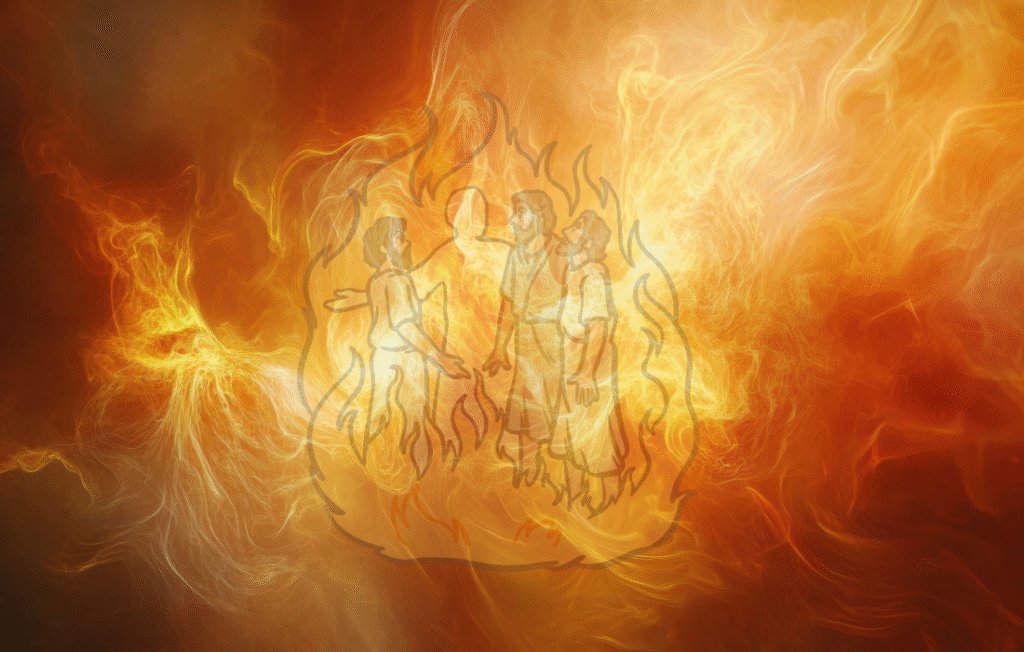
The Arrogance of Enraged King (Daniel 3:19-25)
Enraged by their defiance, the king commanded the furnace be heated seven times hotter than usual. The fire was so intense that it instantly killed the mighty men who threw the Hebrews into the flames.
The Obedient Resolve Displayed
Daniel 3:16-18 tells us when the king’s officials noticed the three Jews standing upright during the mandatory worship, they were brought before a furious Nebuchadnezzar. The king offered them a chance to recant, but their response stands as one of the most powerful statements of unconditional obedience in Scripture.
Their reply was the ultimate example of faith mastering fear:
“O Nebuchadnezzar, we have no need to answer you in this matter. If that is the case, our God whom we serve is able to deliver us from the burning fiery furnace, and He will deliver us from your hand, O king. But if not, let it be known to you, O king, that we do not serve your gods, nor will we worship the gold image which you have set up”
Their statement reveals the anatomy of true obedience:
- Confidence in God’s Power
They acknowledged that God could deliver them (faith).
- Surrender to God’s Will
They stated that even if God chose not to deliver them (“But if not…”), their obedience would remain absolute. They separated their spiritual commitment from their guaranteed physical safety.
- Absolute Priority:
Their refusal was not fueled by arrogance, but by a higher commitment: the fear of disobeying the living God was greater than the fear of the king’s furnace.
The Protection of El Shaddai
God honored the obedience of these three young men thrown in the furnace seven time hotter then the usual. They were indeed thrown into the terrifying center of the fire. But something strange took place. Four men were seen in the fire. “Look! I see four men loose, walking in the midst of the fire; and they are not hurt, and the form of the fourth is like the Son of God” Daniel 3:25.
The three men stood their ground, literally, in the face of the fire. Their garments intact, and “the smell of fire was not on them.” God did not prevent the trial, but rather met them in the trial. Their unwavering obedience resulted in a profound public display of God’s power and sovereignty.
Obedience to God takes Precedence
The example of Shadrach, Meshach, and Abednego is very powerful. It reveals the eternal truth that fear does not nullify faith, but defines it. These men were not superhuman; they were human beings facing genuine, life-ending terror. Their fearless and bold stance was not rooted in an assurance of physical safety, but in the absolute certainty of God’s sovereignty. The furnace was real, the decree was deadly, yet their faithful obedience served as the pathway to God’s immediate presence.
This concludes with a challenge for us: true spiritual courage is measured by our willingness to choose God’s command—even when facing life-altering consequences—knowing that obedience guarantees us the highest reward: the unbroken fellowship and deliverance that comes only from His presence.
Be Blessed.Hoping to see you soon for another read.