
From the moment we take our first breath, life introduces us to authority. Parents set boundaries, teachers guide us, and society enforces rules that shape our growth. Obedience, therefore, is not just an abstract idea it is both deeply personal and universally experienced.
When I reflect on my own experiences with obedience, I notice several influences that shape how we respond to authority. Some are internal, such as personal values and conscience, while others are external, such as laws, traditions, and cultural norms. This brings us to a fundamental question:
What is Obedience?
At its simplest, obedience is defined as:
- Submitting to the restraint or command of authority, and
- Complying with a command, prohibition, or known law.
In practice, it means following instructions or commands given by an authority figure. These figures can be parents, teachers, leaders, governments, or religious guides.
Obedience, however, isn’t one-dimensional—it appears in many aspects of daily life. Let’s explore.
Instances of Obedience in Daily Life
| S.No | Obedience Instance | Examples |
| 1 | Legal Obedience | Traffic Laws |
| Paying Taxes | ||
| 2 | Institutional Obedience | Workplace Laws |
| School Rules | ||
| 3 | Social Obedience | Culture & Customs |
| Social Hierarchy | ||
| 4 | Family Obedience | Obeying Parents |
| Respecting Elders | ||
| 5 | Civic Obedience | Respect Authority |
| Voting | ||
| 6 | Moral Obedience | Ethical Principals |
| Truthfulness | ||
| 7 | Religious Obedience | Divine Commandments |
| Religious Activities |
The Continuum: From Defiance to Compliance
Obedience is not simply about doing what we are told. It exists on a spectrum. On one end lies defiance to the rejection of authority and on the other lies compliance with a wholehearted acceptance of authority. Most people find themselves somewhere in between, sometimes resisting, sometimes surrendering.
Cultural, psychological, and even emotional factors shape how we interpret obedience. In some societies, obedience to authority is non-negotiable, while in others, questioning authority is seen as a virtue.
Obedience as a Human Trait
Despite its complexity, obedience is generally regarded as a positive human trait. It fosters respect, discipline, and order. Communities thrive when individuals willingly submit to shared rules and moral values. Without obedience, chaos would overwhelm progress and peace.
Motivations for Obedience
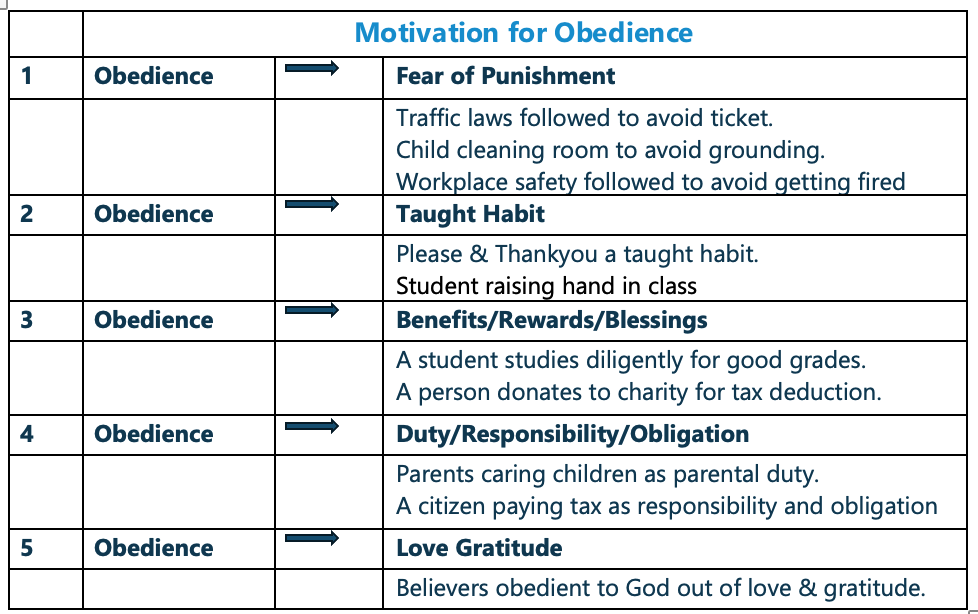
In this discussion, we have considered obedience as a human experience, something that binds societies together and reflects our values. Yet for a Christian, obedience carries a deeper meaning. It is not only about law and order but also about love and faith.
In our next post, we will shift from a general view of obedience to the believer’s perspective of obedience to God.
Stay with me as we continue this journey into the heart of Christian obedience.