
Trust, Cost, and Divine Direction
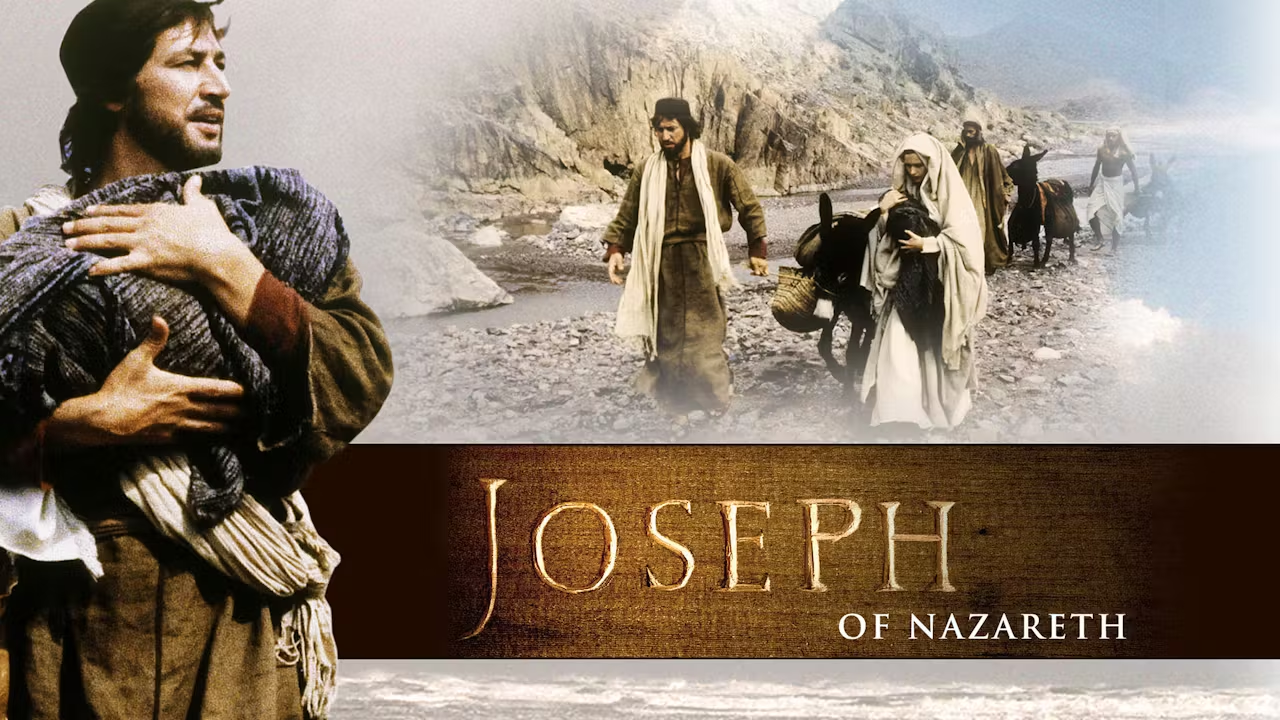
The Gospel of Matthew reserves a unique space for Joseph of Nazareth, the quiet carpenter whose faith was expressed not in words, but in perfect, costly action. Joseph’s story is a profound, case study in obedience rooted entirely in divine trust. His submission was not a single, easy choice, but a pattern of yielding his personal reputation, professional stability, and carefully laid plans to the whispered instructions of God, revealed simply in his dreams. It is this silent, life-long dedication that proved essential for the physical protection of the Christ Child and the fulfillment of Old Testament prophecy. Let’s learn more about Joseph through his recorded actions in the Bible.

Trust Over Logic and Appearance:
Matthew 1:19 tell us that Joseph was a Just man.As a “just man,” he was bound by the Mosaic Law, which, in the context of a legally binding betrothal, could have demanded severe public consequences for Mary’s apparent infidelity. By choosing to act in secret, Joseph sought to fulfill the Law while extending mercy, demonstrating compassion even in the face of what appeared to be personal betrayal. Joseph’s initial plan was “just” and rational: quietly divorce Mary.Though his plan was to be done in quiet.His honorable and legal course of action was to dismiss her quietly, preserving her life but ending their relationship and protecting his own reputation.
But the angel instructed him otherwise. The angel of God brought a message:
- to abandon observable reality,a pregnant fiancé.
- and trust an unseen, supernatural explanation,conception by the Holy Spirit.
Accepting a divine truth revealed solely in a dream over the undeniable testimony of his senses and the pressures of his community.The command was perhaps the most socially challenging. Joseph’s reality was beyond his social and cultural understanding. It defied all all natural laws. His obedience, therefore, was a radical leap of faith.
Immediacy and Decisiveness:
It was not only a radical leap of faith, but also required quick response. Matthew 1:24 The scripture states,
- “When Joseph woke up,
- he did what the angel of the Lord had commanded him and took Mary as his wife”.
There is no recorded hesitation, debate, or delay. Joseph rejected and overcome all the fears of the societal norms and pressures. He rose and acted immediately upon receiving the divine instruction, showing total submission to the dream.
Submission of Personal Honor
As the Bible tells us that he was a just man. He was required to obey Mosaic Law. But Joseph submitted and obeyed the angel of God. He followed the instructions by taking Mary as his wife.
- Joseph surrendered his personal reputation.
- He risked public ridicule and social stigma.
- He obeyed going against the cultural obligations.
His obedience prioritized obeying God in a situation that totally put him into a very difficult situation. But by obeying he was protecting Mary and the Christ Child over preserving his own social standing by accepting a divine truth revealed solely to him.
Quiet and Unquestioning Acceptance:
In this biblical account Joseph does not speak a single word. th His obedience was silent and total. He acted, demonstrating a profound internal conviction that required no external validation or lengthy discussion.
Prioritising God’s Command over his Realities
He essentially accepted the public belief that the child was his, or worse, that he had wed a dishonored woman. His immediate obedience demonstrates that divine direction immediately superseded personal honor and social norms.
- Joseph had to set aside his sense of justice.
- He has to set aside his own logic.
- His fear of public ridicule.
As a noble and just man his realities on ground required different action. But he completely rejected all that was humanly required of him and submitted and did what God required of him.
His obedience was an act of worship. By taking Mary, he became the legal and spiritual head of the Holy Family, ensuring the fulfillment of prophecies concerning Jesus’s lineage from David
In conclusion, this is a powerful story. It shows us three elements, Trust, Cost, and Divine Direction.
- Joseph’s Trust was absolute, choosing the unseen word of an angel over what he saw with his eyes and the ruin of his social standing.
- The Cost was total, forcing him to sacrifice his reputation, his home, and his livelihood, turning him into a perpetual pilgrim.
- Yet, his every action was a response to Divine Direction, ensuring not only the survival of the Son of God but the perfect, sequential fulfillment of prophecy—from establishing the Davidic lineage to the flight into Egypt and the eventual settlement in Nazareth.
Joseph’s quiet, decisive acts of submission give us a timeless lesson: true faithfulness often demands a costly, trusting response to God’s direction, carried out immediately and without the need for applause.It is my prayers that God will enable us to be the disciples who can put an absolute trust in the one who sacrificed his life for me and you and all humanity.
We invite you to remain connected with our community and look forward to our next time together.